Human Karaoke人工卡拉OK · 我彈琴你唱歌
Each chord is a brushstroke of color painted across the canvas of time.
每個和弦都是畫在時間畫布上的一筆色彩。
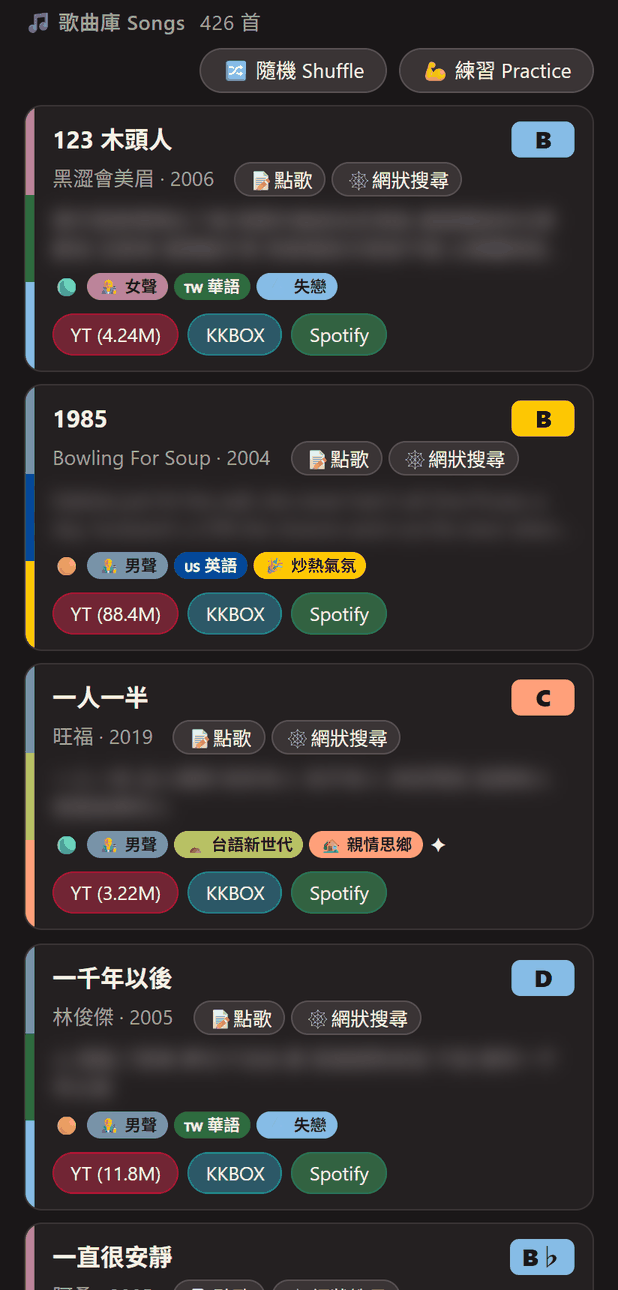
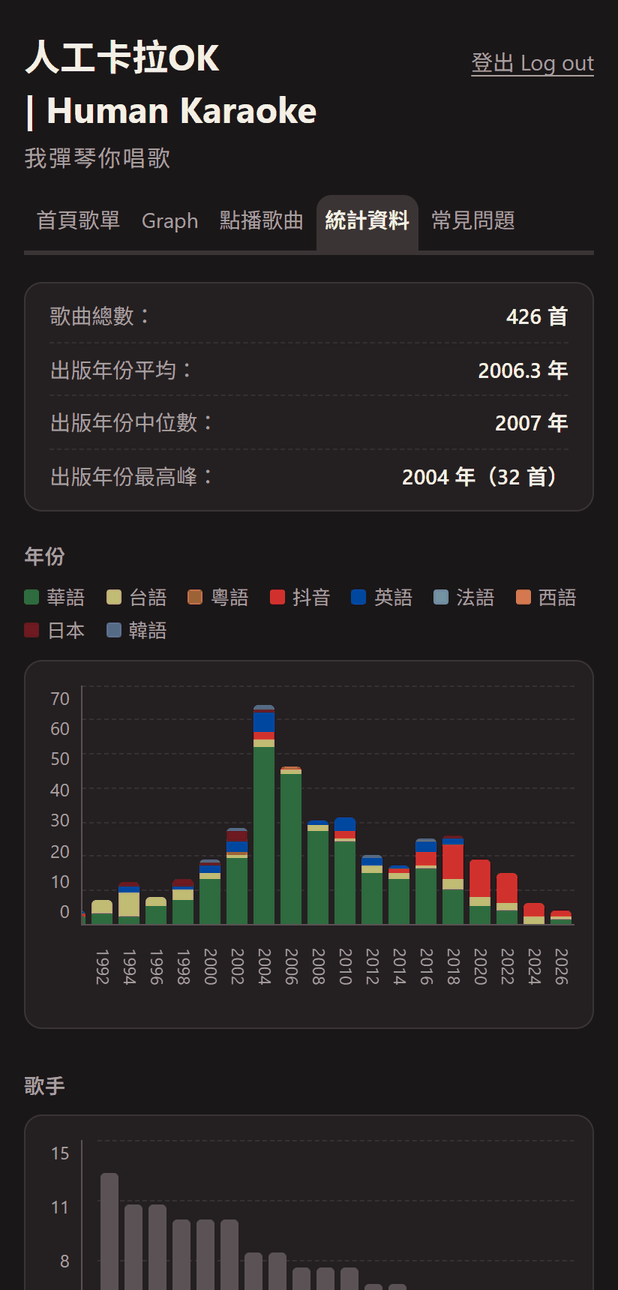
I wanted to record my practice and play pop songs fast, so I needed the song name, the key, the next song and the first line in one place. I turned that into a songbook, so friends can browse 426 songs on their phones and request one while I play.
The demo is the real interface on the real songbook, read-only: the server refuses requests, votes and admin actions from it.
Why it exists
To be honest, I am not that into singing. With some natural talent, if you can find the note and follow the beat, singing goes from zero to 60 points, and with a bit of practice to 80. But 95 or 100 feels like it needs a new set of vocal cords. I enjoy playing piano much more. Every chord feels like a splash of color in time, reflecting a shift in emotion, and there is something incredibly satisfying about figuring out the next right chord of the next measure, again and again, as the music comes forward.
I started in the third or fourth year of elementary school, on an electric organ with two rows of keys and a bass keyboard for the left foot. I was playing Joe Hisaishi's anime music, got too impatient reading the score, and started playing pop songs instead. That is when I found my talent for it. In junior high I first played while friends sang, in a music practice room and on the piano in our school auditorium, and the moment the chorus matched the music was just exciting.
The songbook started on paper. In August 2026, at a friend's home, I handed out a printed list of fewer than 50 songs, sorted by the emotion of each song. A friend's very direct suggestion was a filter by voice, so she could find the songs she can sing. That was the motivation to move everything online.
The first time someone cried while I played was in 2014, on a piano in a laundry room at UC San Diego, during an exchange program. My future wife had requested 〈P.S. 我愛你〉 by A-Lin. I think people memorize a song because of the emotion it carries, the feeling of themselves at that period of time. We cannot always say what we feel so directly, so we rely on poetry, movies and songs, and let the artist express the emotion for us. That is why the songbook can sort by your birth year: the songs from your teens are the ones you remember.
No matter how good AI gets, people often care more about who is singing than how well they sing. Even before AI, an edit that made a Donald Trump speech sing "Call Me Maybe" went viral, while tons of ordinary covers barely got any attention.
Karaoke is a small ritual of shared vulnerability.
卡拉 OK 是一場共同展露脆弱的小儀式。
A voice may crack, lyrics may vanish, a rhythm may slip away, yet it is precisely the possibility of failure that gives the act of stepping forward its meaning. It is the fragility of our ability that lends beauty to our effort. Playing piano while someone sings shows even more of that vulnerability, and that makes it much more interesting to me.
Were perfection guaranteed, courage would have no place upon the stage.
如果完美是必然的,勇氣在舞台上便沒有立足之地。
Why build it myself? I am doing a PhD in electrical engineering and computer science, and I want to start a company, where SaaS concepts and technique are extremely important. This project is my practice of SaaS. As AI comes up, the coding is basically solved, so what is left is your idea, your ambition, what you dare to try.
My wife and I go to a bar with live bands on weekend nights, and every time we say the same sentence to each other: everyone needs a hobby. A hobby generates happiness, and it is better if it makes something. I chose music because I like the math inside it: whenever I play a song I have to shift the key quickly and calculate the next position of my left hand, with the circle of fifths kept in mind. It gives me happiness, a blog post, this portfolio, and maybe one day a music bar of my own. It is a hobby I invest in, both as a hobby and as a career.
How it works
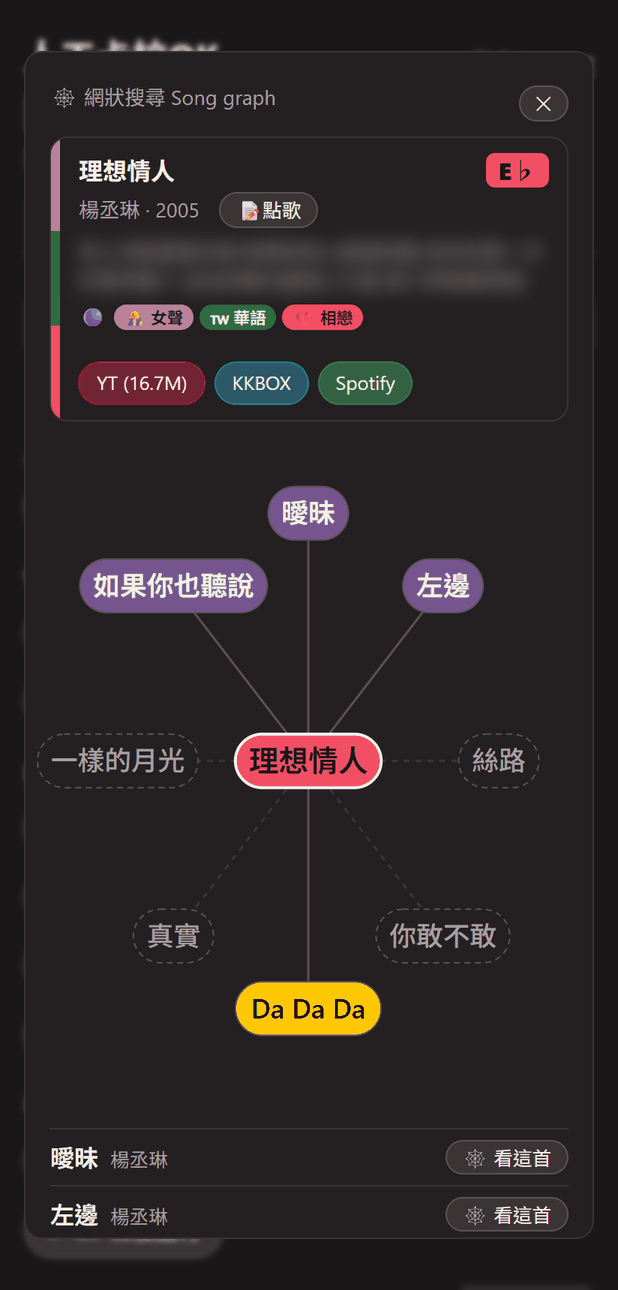
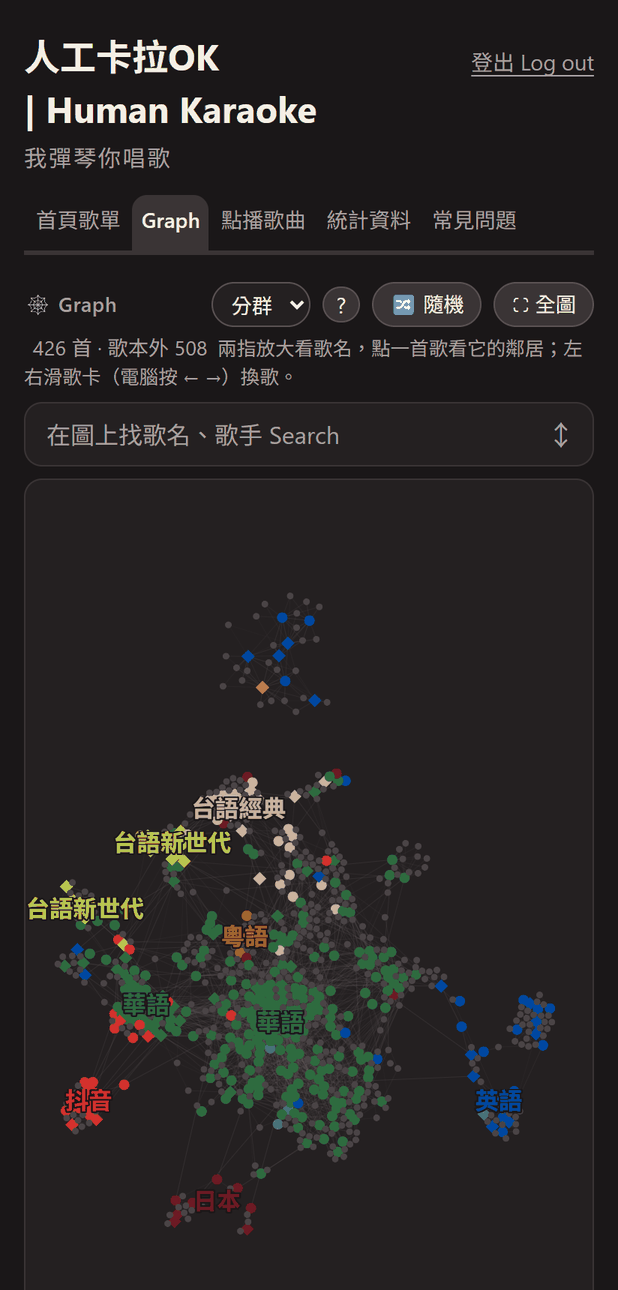
- A song is not just a song. At my 2025 internship at Synopsys I worked on a circuit foundation model, where a graph shows how the devices in a circuit relate: a resistor is not just a resistor, because in a different place it plays a different role. Songs that people listen to together have connections too, so each song has a ring of related songs, and people with a similar cultural background turn out to listen to the same music. Spotify keeps tightening access to this kind of data, and Last.fm is the source that is left, which tells me the information is valuable.
- I show every song, not just the ones I play well, so people know what they can sing. If they ask for a song I am not good at yet, I try it, because playing is a great moment of practice. The colored light on each card is how ready I feel, and purple means a complete recording exists, hard evidence that I really played it. I am not aiming to play ten songs perfectly. I am aiming to play a hundred, or even a thousand songs well enough that people can sing along.
- The door is there for the lyrics: every card carries the first line, so visitors answer a small question at the gate, checked on the server, before the songbook loads. Friends who meet it simply ask me. For a reviewer, the demo above opens the same songbook read-only.
- Coding is basically solved in this AI era, so AI agents write most of the code. What I do is decide what I want, use what I know from electrical engineering to think about what comes next, and ask the agents whether it is possible and what a better way would be. The song graph came from my circuit work; Last.fm came from an agent. With one we pinned down the limits of this setup: a soft limit of 500 songs and a hard limit of 1,000, beyond which it needs to change.
Screens
Built with
- Cloudflare Pages
- Pages Functions
- D1 (SQLite)
- Vanilla JS
- Python data pipeline
- Spotify, KKBOX, YouTube, Last.fm APIs
- AI coding agents
What I learned
- Start the music yourself. At the first event, a Mid-Autumn potluck with my keyboard on the lawn, I was too nervous and did not play many songs. The crowd was mostly parents watching their kids, and it really needs one or two people who love to sing before the room rises. Next time I will sing ten songs myself instead of waiting for requests, because the vibe has to be exciting before people feel like requesting.
- Pick the song the room can sing. The music should bring joy to the people around you; it is not just your moment of showing off. For an audience that is not Chinese, I would play "Country Roads, Take Me Home". It is a cliché, but most people can sing it.
- A score is a kind of recording. I do not like the classical habit of preparing one or two pieces and playing them flawlessly. If I read my notes while talking with you, would you think I am genuine? What I value is how you react in real time, like a debate without a script. I like to improvise.
- The login should change. My SmartHome project already has a much better login system, and Human Karaoke should adopt it.
Status
Live and used at gatherings since September 2026. Next is a set of three to five songs that connect in key or mood and can be played as one flow, and meanwhile to keep practicing and recording. Ten years from now I hope to open this page next to a piano, looking for the songs that hold my nostalgia, my zeitgeist, and to see how the graph has changed.
If you are reading this from my application, this is what I hope it shows: I have the momentum and the skill to build something when I am not being paid to do so.
Perfection may fill the room with music, but companionship fills it with meaning.
完美可以讓音樂充滿房間,而陪伴才能讓房間充滿意義。
That is why the playing stays human.